
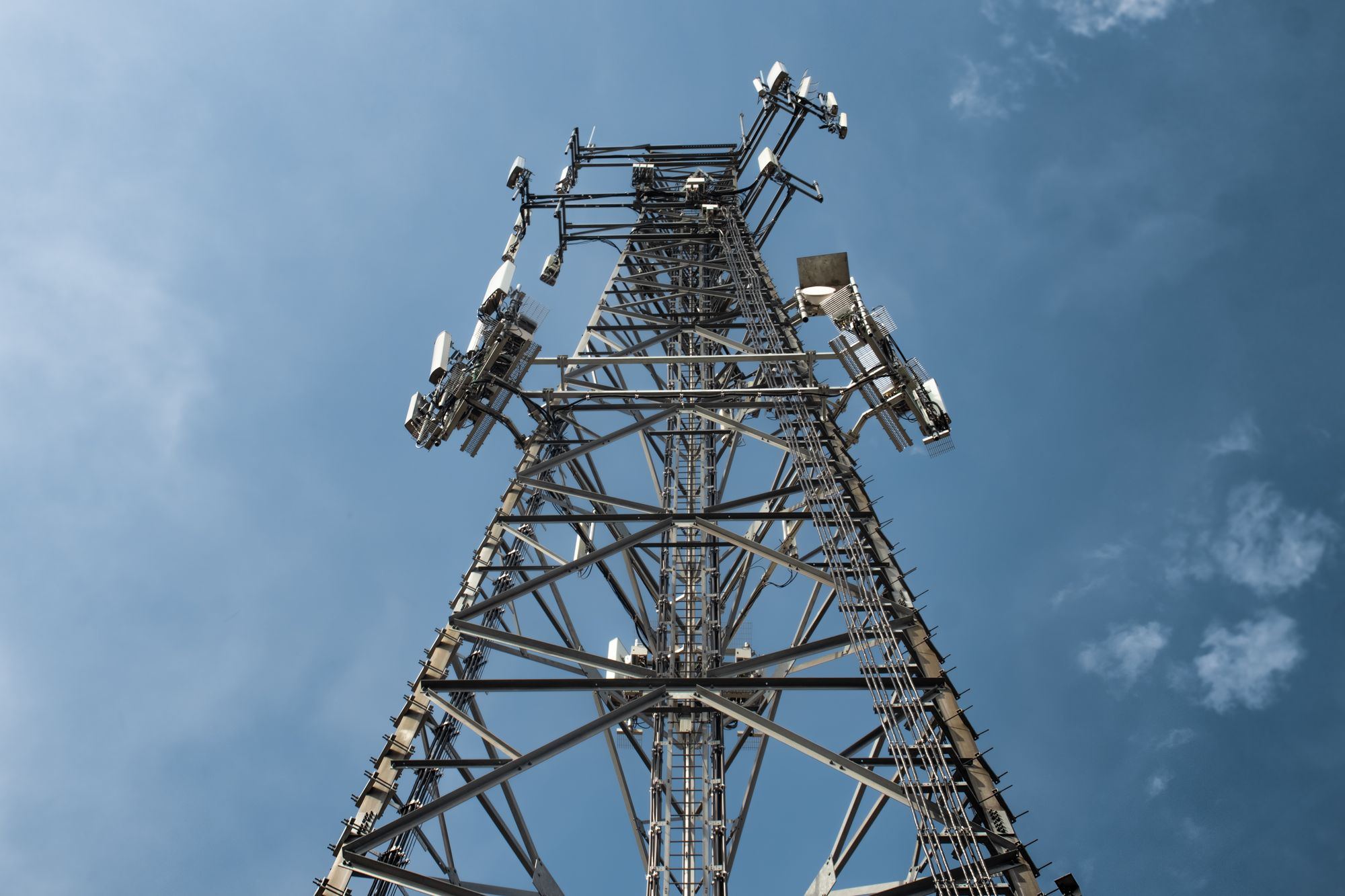
Construction sites, Permits and approvals
Connectivity for desert construction sites in Egypt
Microwave, fibre, mobile and satellite compared, with NTRA approvals, an 8-week programme and the status of Starlink.
By Senses Innovations LLC, Published , 8 min read
A desert construction site in Egypt can be connected in four licensed ways: a licensed microwave link from an operator, carried on a site mast; operator fibre where a route exists; mobile coverage from the licensed operators; or satellite (very small aperture terminal, VSAT) through a licensed provider. Each depends on licences from the National Telecom Regulatory Authority (NTRA) [1].
On our Gulf of Suez projects we have used a licensed microwave link from a licensed operator as the main connection, from Ras Ghareb Wind Energy in 2017 to Suez Wind Energy in 2025.
Microwave, fibre, mobile and satellite compared
- Option
- Licensed microwave link via a site mast
- Who provides it
- A licensed operator, such as Orange
- What the site needs
- A mast (30 m in our standard design), power and line of sight to the operator’s network
- Main strength
- High capacity, independent of cable routes
- Main limit
- Needs line of sight, and approvals before installation
- Option
- Operator fibre
- Who provides it
- The fixed-line operator
- What the site needs
- A fibre route to the site, with civil works along it
- Main strength
- High, stable capacity
- Main limit
- Often not available near remote desert sites
- Option
- Mobile coverage
- Who provides it
- The licensed mobile operators
- What the site needs
- Existing coverage, or a dedicated coverage site
- Main strength
- Serves phones across a large site
- Main limit
- Coverage may be weak or absent at remote sites
- Option
- Satellite (VSAT)
- Who provides it
- An NTRA-licensed VSAT service provider
- What the site needs
- A dish with a clear view of the satellite, and power
- Main strength
- Works wherever the satellite is visible; useful as a backup
- Main limit
- Higher delay than terrestrial links, which affects voice and video calls
Large sites can combine options. On Suez Wind Energy, we delivered NTRA-licensed 2G, 3G and 4G LTE mobile coverage for 1,000 concurrent users at the north site. It uses solar-diesel hybrid power and the site’s microwave backhaul.
Approvals from NTRA and the Armed Forces
The table describes the approvals in general terms, from NTRA’s own documents and Egypt’s Telecommunication Regulation Law (Law No. 10 of 2003). The detail depends on the site, the equipment and the operator, so confirm the current requirements with NTRA and your legal adviser.
- Subject
- Frequencies
- What the rule says
- Using a radio frequency needs an NTRA licence. NTRA takes the requirements of the Armed Forces and national security entities into account, and decides within 90 days of receiving a complete file.
- Source
- Law No. 10 of 2003, Article 51 [1]
- Subject
- Microwave links
- What the rule says
- Links are normally assigned individual frequencies and licensed link by link. Applications go through NTRA’s e-services portal with the site coordinates, antenna data and height, and equipment data.
- Source
- NTRA fixed links guidelines, June 2021 [2]
- Subject
- Masts and cables
- What the rule says
- A network licensee needs approvals from the Armed Forces and other concerned entities before it erects towers or lays cables near roads, waterways and railways. NTRA also issues a separate licence to companies that build and lease towers.
- Subject
- Equipment
- What the rule says
- Importing telecommunication equipment needs an NTRA licence, and installing or operating a radio set needs NTRA consent. Buy radio equipment from suppliers who can show the NTRA approvals.
- Source
- Law No. 10 of 2003, Articles 44 and 52 [1]
- Subject
- Satellite
- What the rule says
- No earth station may operate in Egypt without a prior NTRA licence, and NTRA’s licensing framework includes a VSAT service licence. A site using VSAT therefore buys the service from a licensed provider.
In practice, we prepare and coordinate the NTRA and military approvals for the site’s microwave link. The link itself is a service from a licensed operator. The client signs the operator’s service agreement directly, and we add no markup to the connection.
An 8-week programme from survey to handover
Our standard programme takes about 8 weeks from survey to handover:
- Survey and line of sight. We survey the site, confirm line of sight from the mast position to the operator’s network and produce a predictive Wi-Fi design.
- Approvals. We prepare the NTRA and military approval file for the microwave link as soon as the survey is complete. Approval times are set by the authorities, and the programme depends on them. The 90-day maximum in Article 51 [1] is why the approval file goes in this early.
- Procurement and civil works. Equipment is ordered, and the mast foundation and other civil works are built.
- Installation. The 30 m mast, the microwave link, the network equipment and the access points go in. The engineering, procurement and construction (EPC) contractor cables to the access point layout we issued at survey.
- Commissioning and handover. We run the site acceptance test (SAT) and issue the handover pack: as-built drawings, IP and virtual LAN (VLAN) inventory, test reports, port matrix and wireless survey report.
On Infinity Power’s 200 MW site at Ras Ghareb, for PowerChina, survey to go-live took 7 weeks.
Our Site Mobilization service covers every step, including the separate networks for the owner, the EPC contractor and subcontractors.
Power and desert conditions
Until the site has permanent power, the communications equipment runs on site generators. Plan for three things:
- Independent power for remote equipment. On Suez Wind Energy, the mobile coverage site uses solar-diesel hybrid power.
- Cabinets and shelters rated for desert heat and dust, with cooling sized for summer.
- Earthing and lightning protection for the mast, and a structure designed for the strong winds that bring wind farms to the Gulf of Suez.
Under our managed service, automated monitoring runs 24 hours a day and raises an alert when the link or a site device goes down, whatever the cause.
Starlink status in Egypt as of 8 October 2026
As of 8 October 2026, we have found no NTRA licence or public NTRA decision that authorizes Starlink service in Egypt. Starlink’s own availability data, as summarized by an independent tracker on 10 May 2026, placed Egypt among countries awaiting service with no launch date [5]. NTRA’s satellite earth station guidelines state that earth stations may not operate in Egypt without a prior NTRA licence [3].
We are not able to give a legal opinion on Starlink, and we have found no primary source that settles the question. Until NTRA licenses a low-earth-orbit satellite service, we plan sites on the licensed options in the table above. We will update this article if the position changes.
Frequently asked questions
How do you get internet on a remote construction site in Egypt?
The usual route is a licensed microwave link from a licensed operator, carried on a mast at the site, with NTRA and military approvals. Fibre, mobile coverage and VSAT through a licensed provider are the alternatives. On our Gulf of Suez sites the microwave link has been the main connection.
Is Starlink legal in Egypt?
We cannot give a legal opinion. As of 8 October 2026, we found no NTRA licence or public decision authorizing Starlink service in Egypt, and NTRA’s guidelines require a prior licence for any earth station operating in Egypt [3]. Check the current position with NTRA or your legal adviser before planning to use it.
Can a construction site use VSAT in Egypt?
NTRA’s licensing framework includes a VSAT service licence [4], so a site can buy VSAT service from a licensed provider. Check the provider’s licence before you sign.
Which approvals does a site microwave link need?
How long does it take to connect a desert construction site?
Our standard programme takes about 8 weeks from survey to handover. On Infinity Power’s 200 MW site, survey to go-live took 7 weeks.
Sources
- Source 1National Telecom Regulatory Authority (NTRA), Telecommunication Regulation Law No. 10 of 2003, English translation (the Arabic text prevails), Articles 35, 44, 51 and 52. https://tra.gov.eg/rules/law-no-10-of-2003 (accessed 8 October 2026). Text-searchable copy of the NTRA translation: https://hrlibrary.law.umn.edu/research/Egypt/Egypt%20Telecommunication%20Regulation%20Law.pdf.
- Source 2NTRA, Radio Spectrum Guidelines: Fixed Links Radio Stations, release 1.0 (active), June 2021. https://www.tra.gov.eg/wp-content/uploads/2021/06/EGY-NTRA-June21-Fixed.pdf (accessed 8 October 2026).
- Source 3NTRA, Radio Spectrum Guidelines: Satellite Earth Stations, issue 1.0 (cover dated September 2021; active from May 2022), sections 7.4 and 7.9. https://www.tra.gov.eg/wp-content/uploads/2022/05/Satellite-Earth-Stations.pdf (accessed 8 October 2026).
- Source 4NTRA, The Rules and Conditions of the Award of Licence to Establish Telecom Networks and Provide Telecom Services in A.R.E. (undated; file path November 2020), lists of satellite services and infrastructure leasing licences. https://www.tra.gov.eg/wp-content/uploads/2020/11/Telecom-Service-Regulatory-Framework-English.pdf (accessed 8 October 2026).
- Source 5Mappr, Where Starlink is available around the world, updated 10 May 2026, based on Starlink’s published availability data (secondary source). https://www.mappr.co/starlink-availability-by-country/ (accessed 8 October 2026).
Project facts (Ras Ghareb Wind Energy, Infinity Power, Suez Wind Energy, the standard programme and handover pack) come from Senses Innovations project records, as of October 2026.